Mastering Rock Fragmentation: Advanced Technologies in Modern Drilling
August 4, 2026 | by admin
Executive Summary
Rock fragmentation is the foundational process in resource extraction, tunnel construction, and deep well drilling. Because rock formations exhibit significant anisotropy, heterogeneity, and brittleness, relying on a single fragmentation method is often insufficient for complex geological conditions. Modern engineering has evolved far beyond basic mechanical crushing, developing a sophisticated ecosystem of high-pressure impactors, specialized drill bits, and composite bottom hole assemblies (BHAs). This article provides an in-depth analysis of these advanced technologies and their strategic application in diverse geological environments, with a special focus on the cemented tungsten carbide components that make these tools possible — the same materials HARDCARBIDE manufactures for the global drilling industry.
I. Advanced Impact Technologies: High & Medium Air Pressure and Reverse Circulation
The evolution of pneumatic impactors has fundamentally transformed hard rock drilling efficiency, moving beyond standard low-pressure systems to highly specialized designs.
High and Medium Air Pressure DTH Hammers
Down-the-Hole (DTH) hammers are critical for hard rock applications. Medium air pressure hammers typically operate between 1.0 and 1.7 MPa, offering a balanced solution with moderate fuel consumption and reliable penetration rates in medium-hard formations. High air pressure DTH hammers, operating above 2.0 MPa, deliver significantly higher impact energy and frequency. This makes them exceptionally effective in hard and extremely hard, abrasive rock formations like granite and basalt, where rapid fragmentation is essential.
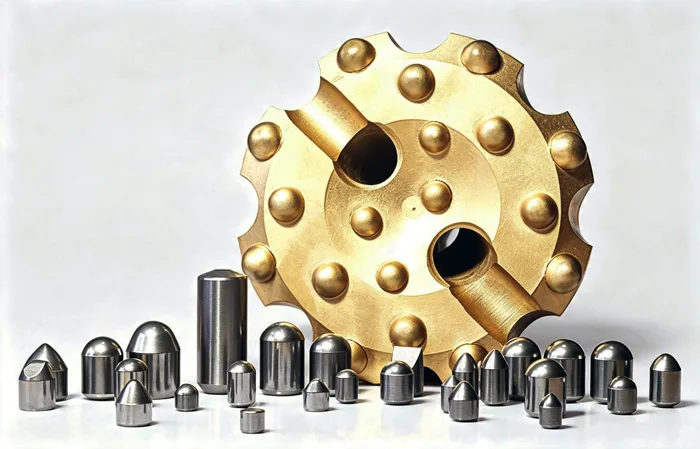
The tungsten carbide button bits that drive these hammers must withstand extreme percussive loads, often exceeding 20 joules per blow at frequencies above 20 Hz. Premium grades such as YG11C and YG13C, with cobalt content carefully balanced between 9% and 11%, provide the optimal combination of hardness (HRA 88+), transverse rupture strength, and thermal fatigue resistance needed for sustained high-pressure operation.
Reverse Circulation (RC) Impactors
For geological exploration where sample integrity is paramount, Reverse Circulation impactors represent a major technological leap. Unlike conventional DTH hammers where cuttings are evacuated through the annulus, RC systems utilize a dual-wall drill pipe. The compressed air travels down the annulus to power the hammer, while the cuttings are evacuated through the inner tube directly to the surface. This mechanism ensures rapid, uncontaminated sample recovery and prevents borehole collapse in unconsolidated or fractured formations, making it the industry standard for mineral exploration.
II. Specialized Drill Bits: Matching Geometry to Geology
The drill bit is the direct rock-breaking tool, and its design must be meticulously matched to the rock’s mechanical properties.
Tricone Roller Bits
Tricone bits employ a combination of crushing, shearing, and impact actions. The rolling motion of the cones, combined with engineered slippage (such as offset or skew), generates high-frequency impacts and shear forces. Bits with milled teeth are ideal for soft to medium formations, while those with tungsten carbide inserts (TCI) are designed for hard, abrasive rocks. Their versatility makes them a staple in open-pit mining and large-diameter water well drilling.
Each TCI bit can contain over a hundred individually pressed and HIP-sintered tungsten carbide buttons, each engineered with a specific conical, spherical, or chisel profile. The interface metallurgy between the pressed carbide button and the forged steel body is the critical failure point; modern diffusion-bonding techniques have pushed TCI bit service intervals beyond 1,500 hours in medium formations.
PDC Bits: Shear Dominance in Hard Rock
Polycrystalline Diamond Compact (PDC) bits have revolutionized drilling by utilizing a shear-cutting mechanism rather than crushing. Historically limited to soft formations, advancements in cutter technology (such as thermally stable PDC and shaped cutters) have expanded their application into medium-hard and even some hard rock formations. PDC bits offer superior Rate of Penetration (ROP) and longer life in homogeneous formations where abrasive wear is the primary failure mode.
Core Bits and Geological Drilling Tools
In mineral exploration and geotechnical investigations, preserving the rock core is essential. Diamond core bits, utilizing surface-set or impregnated industrial diamonds, grind through hard rock formations with high precision. These bits are designed to maintain dimensional stability and minimize deviation at great depths, providing geologists with pristine samples for analysis.

III. Composite Bottom Hole Assemblies: The Future of Drilling
The most significant trend in modern drilling is the integration of multiple fragmentation mechanisms into composite BHAs to overcome specific downhole challenges.
Torque-Generating Impact Tools
One of the most promising innovations is the combination of axial impact with torsional vibration. These tools convert hydraulic energy into alternating axial and torsional impacts, creating a three-dimensional "volumetric rock breaking" effect. When placed above a PDC bit in hard, abrasive formations, this composite action dramatically reduces stick-slip vibrations, improves ROP by up to 30-50%, and significantly extends bit life.
High-Torque Drilling Systems
For horizontal directional drilling (HDD) in hard rock, standard rotary systems often lack the necessary torque. Specialized high-torque drilling rigs, capable of delivering output torques exceeding 40 kN·m, are now being deployed. These systems often integrate high-pressure jet-assisted rock breaking and advanced measurement-while-drilling (MWD) guidance to navigate complex hard rock strata with precision.
Hybrid Drilling Approaches
The industry is also exploring hybrid approaches that combine mechanical cutting with other energy sources. For instance, integrating percussive mechanisms with roller cone bits creates a hybrid tool that leverages both the continuous crushing action of rollers and the high-frequency impact of a hammer, optimizing performance in interbedded or heterogeneous formations.
IV. Strategic Selection: A Systems Approach
Selecting the optimal rock fragmentation strategy is no longer about choosing a single tool; it is about engineering a complete system. The decision matrix must consider:
- Rock Properties: Unconfined compressive strength, abrasiveness, brittleness, and fracture toughness.
- Operational Constraints: Available air pressure, rig torque capacity, and hole diameter requirements.
- Project Objectives: Whether the priority is maximum penetration rate, core sample quality, or minimizing cost per meter.
The future of rock fragmentation lies in intelligent, adaptive systems that can dynamically adjust impact frequency, torque, and weight on bit in real-time response to changing downhole conditions. As drilling targets move deeper and into more challenging geological environments, the integration of advanced impactors, specialized bits, and composite BHAs will continue to drive efficiency and unlock new frontiers in subsurface engineering.
V. Why Carbide Grade Matters: The HARDCARBIDE Perspective
Behind every breakthrough in drilling performance is an upstream revolution in cemented carbide manufacturing. As a specialized producer of tungsten carbide components, HARDCARBIDE supplies the wear-resistant, impact-resistant button inserts, TCI teeth, and PDC cutter substrates that form the cutting structure of the tools described above. Our mining-grade carbide is produced via wet mixing, cold isostatic pressing, vacuum sintering, and hot isostatic pressing (HIP), delivering the consistent density, fine-grained microstructure, and predictable wear behavior that modern drilling tools demand.
For drill bit manufacturers and mining tooling distributors, the right carbide grade is the single largest determinant of tool life. Reach out to HARDCARBIDE for:
- Custom-engineered tungsten carbide button bits in conical, spherical, and chisel profiles
- TCI teeth blanks in grades from YG6 to YG15, with cobalt content dialed to your formation
- PDC cutter substrate rods and preforms, manufactured to your cutter supplier’s tolerance
- Reverse-engineering and grade optimization for legacy bit lines
Looking for a manufacturing partner for your next mining drill bit production run? Contact HARDCARBIDE today for factory-direct quotes, grade recommendations, and OEM/ODM tooling solutions tailored to your geological target.